Language Access Requirements for 2027
Federal agencies have revised language access requirements several times in recent years, and the shifting regulatory landscape has left many organizations uncertain about what their current obligations are. This includes revoking
Executive Order 13166, the executive order that established the framework for language access guidance for federally funded programs. The Department of Justice also
withdrew the 2002 LEP guidance for federally funded organizations and suspended
LEP.gov.
Yet the underlying laws have not changed. Federal statutes like
Title VI and
Section 1557 still require
meaningful access for people with limited English proficiency. Some states add requirements of their own.
Regulatory questions aside, language barriers are barriers to using your services. In one Illinois Medicaid study, LEP enrollees who received renewal notices only in English were disenrolled at
more than five times the rate of English-proficient peers.
To better serve your LEP members and patients, use the following questions to identify where your plan needs attention.
1. How well do you know the people you serve?
Without current data on the languages your members, patients, or policyholders speak, organizations struggle to arrange for the appropriate translation and interpreting services ahead of time.
A best practice is to ask for spoken and written language separately at enrollment or intake, and record the answer somewhere easily available for future use. Keep language preference data current through periodic verifications or surveys.
2. Can your plan keep up during high-demand periods?
Your language access plan has to provide meaningful access efficiently all year long. That is relatively easy when requests come slowly. Getting thousands of documents translated at once is another matter.
The good news: in most cases, you already have the data you need to plan for high-demand periods. These periods are usually seasonal or otherwise predictable, like Medicare annual enrollment and open enrollment for insurers, or flu season for doctor’s offices.
Look back at the last year and see how well your current plan worked during these times. Did translated documents get to the people who needed them? Were people able to access interpreters without excessive waiting? Pull specifics for historical spikes in volume and check that your team or your language company is prepared to handle them. If not, the time to vet additional language companies and create a backup plan is now.
For example, you might consider:
- Adding a second language services provider
- Using a video remote interpreting option for languages your primary language company covers thinly
- Pre-translating critical documents into commonly spoken languages
Machine translation (or AI translation) can help with volume. However, as the American Translators Association has
noted, "machine translation should not be used without the ongoing involvement of professional translators." Machine translation with qualified human post-editing, delivered under a standard like ISO 18587, is designed to provide that oversight. For documents where the wording affects a person's coverage, care, or legal rights, the
2024 Section 1557 rule specifically requires review by a qualified human translator.
3. Does your plan prioritize accuracy and consistency?
If your language access plan depends on bilingual staff who have not been qualified as linguists, or on unqualified individuals such as friends and family, you may be out of compliance with language access laws. According to Section 1557 of the Affordable Care Act, friends and family and other unqualified individuals should only interpret for patients or members as a temporary measure in an emergency, or when the person who needs interpreting services makes that request privately after being offered an interpreter at no charge. Translation and interpreting require specific skills beyond just fluency, so these are best practices even in situations where Section 1557 does not apply.
For high-stakes communications, linguists (interpreters or translators) should be knowledgeable about the subject matter, specialist vocabulary, and accepted protocols. Ask your language company how they qualify and assign the
linguists they work with.
Using consistent terminology also helps prevent misunderstandings. A glossary of plan and policy terms, shared with every linguist working with your organization, keeps a patient or member from reading one term in a document and hearing a different one on the phone.
4. Are your policies and procedures written down and accessible to your staff?
When language access procedures are documented and published where every employee can find them, requesting an interpreter or submitting documents for translation becomes routine rather than something each person figures out on their own. People who need language services get help faster, and the organization spends less time managing requests that could have followed a standard process. Include these language access processes (and information about where these processes are published) in your training. Ideally, a new hire will be able to request services without having to ask someone else.
5. Do the people you serve know the services exist?
Not everyone who would benefit from an interpreter will ask for help without prompting. That is why the
National CLAS Standards say to tell people, orally and in writing, that language assistance is available at no cost to them. Health plans and providers that receive federal funding
are also required to advertise language services on policy documents using translation taglines, which use the phrase "free of charge."
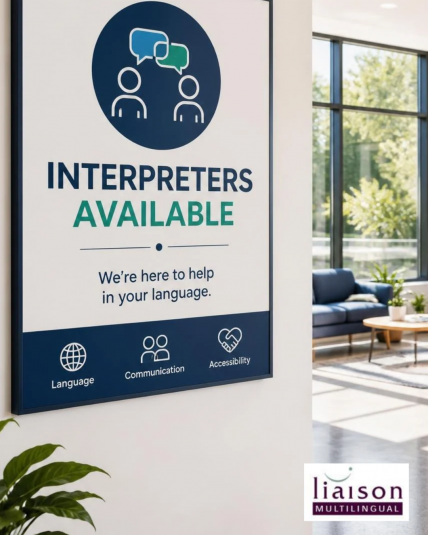
Put the offer of language assistance at every point of contact, in the most common languages you serve: the website, the enrollment packet, the claims letter, the phone tree, and the sign at the front desk. In hospitals and other buildings, use the principles of
language-centered design to improve the experience for people with limited English proficiency.
One important detail that improves service: The wording of the intake question can change how people answer. For example,
in one study, "What language would you like for care today?" produced more interpreter use than a yes-or-no question about wanting one.
6. How do you know the plan works?
Start with unfilled interpreter requests, wait times, and language-related complaints. Some complaints arrive under another label, such as "could not get help" or "did not understand my bill," so read complaint and grievance data with language access in mind.
Where to start
Use the questions in this post to find where your plan is working and where the gaps are. Then factor what you find into your next budget, staffing plan, and language services contracts.
How Liaison Multilingual Supports Language Access Plans
Liaison Multilingual has provided language access and accessibility services since 1998, working in more than 200 languages. We offer document translation, on-site and remote interpreting, machine translation with qualified human post-editing, website and software localization, multilingual speech technology, and accessibility compliance services. Our processes are certified to ISO 17100, ISO 18587, and ASTM F3130-18.
If you want a language services partner who shares your commitment to the people you serve,
contact us. We would welcome the chance to talk about how we can support your language access goals.